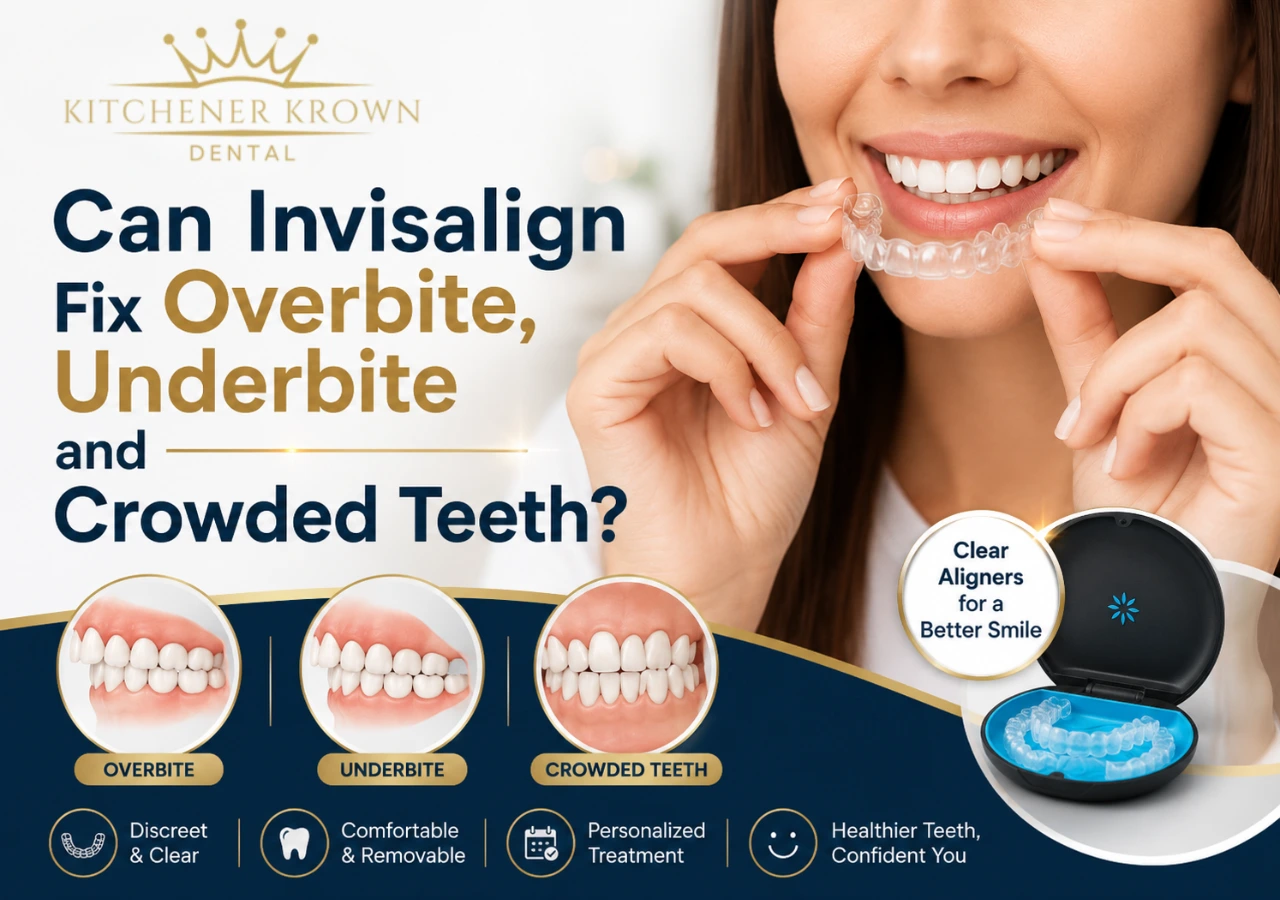
Overbite vs underbite is one of the first questions many patients ask before starting orthodontic treatment. Yes, Invisalign can correct many cases of overbite, underbite and crowded teeth when the required changes can be achieved through controlled tooth movement. However, clear aligners are not suitable for every bite problem. The severity, cause, tooth position, jaw relationship, gum health and treatment goals all influence which orthodontic approach is appropriate.
If you are considering Invisalign in Kitchener, it is important to understand that orthodontic treatment involves more than making teeth look straighter.
A patient may have crowded teeth but a relatively healthy bite. Another patient may have an overbite or underbite that affects how the upper and lower teeth meet. In some cases, the problem is primarily related to tooth position. In others, the relationship between the jaws plays a major role.
That difference can determine whether Invisalign alone is appropriate.
At Kitchener Krown Dental, Invisalign is offered as part of the clinic’s dental services for suitable patients. The practice provides dental care for children, adults and families in Kitchener, Ontario.
What Is the Difference Between an Overbite and an Underbite?
An overbite occurs when the upper front teeth overlap the lower teeth vertically, while an underbite occurs when the lower front teeth sit in front of the upper front teeth. Both are types of malocclusion, a term used to describe an abnormal relationship between teeth or jaws. When comparing overbite vs underbite, the direction of the misalignment is the main distinguishing factor.
Understanding overbite vs underbite is useful because the two conditions can have different causes and treatment requirements.
What is an overbite?
A small amount of vertical overlap between the upper and lower front teeth is normal.
An excessive overlap is generally described as an increased overbite or deep bite.
Depending on its severity, an excessive overbite may be associated with:
-
- Excessive tooth wear
-
- Difficulty biting
-
- Gum irritation
-
- Contact between the lower teeth and surrounding soft tissues
-
- Changes in bite function
-
- Jaw discomfort in some patients
Not every overbite needs orthodontic correction. A dental professional evaluates the bite to determine whether it is affecting oral health, function, comfort or tooth stability.
What is an underbite?
An underbite occurs when the lower front teeth extend ahead of the upper front teeth when the mouth is closed.
An underbite may be related to:
-
- The position of the lower teeth
-
- The position of the upper teeth
-
- The relationship between the upper and lower jaws
-
- A combination of dental and skeletal factors
This distinction is important because Invisalign primarily moves teeth.
If the problem is mainly dental, controlled tooth movement may improve the bite. If there is a significant skeletal discrepancy involving the jaws, clear aligners alone may not provide complete correction.
The American Association of Orthodontists identifies underbite as one condition that may be treated with clear aligners, while emphasizing that treatment depends on the individual case.
Can Invisalign Correct an Overbite?
Yes, Invisalign can correct many overbites by gradually repositioning teeth and improving the relationship between the upper and lower dental arches. The amount of correction possible depends on the severity and cause of the overbite. Regardless of which side of the overbite vs underbite comparison applies to you, the treatment approach starts with the same careful evaluation.
Invisalign uses a series of custom-made clear aligners designed to apply controlled forces to specific teeth.
Depending on the treatment plan, aligners may be used to address:
-
- Excessive tooth overlap
-
- Tooth inclination
-
- Crowding
-
- Spacing
-
- Certain bite relationships
-
- Overall dental alignment
However, correcting an overbite is not necessarily as simple as moving the upper front teeth backward.
The entire bite needs to be considered.
How do you fix an overbite?
The appropriate treatment depends on what is causing the overbite and how severe it is.
Possible treatment approaches include:
-
- Clear aligners for suitable cases
-
- Traditional braces when more complex tooth control is required
-
- Orthodontic elastics or other appliances in selected cases
-
- Space-management procedures in certain situations
-
- Orthognathic surgery for significant skeletal discrepancies
The American Association of Orthodontists recognizes clear aligners as a treatment option for some orthodontic conditions while noting that they are not appropriate for every patient.
When may Invisalign be appropriate for an overbite?
Invisalign may be considered when:
-
- The required tooth movements can be achieved with aligners
-
- The teeth and gums are healthy enough for orthodontic treatment
-
- The patient can follow the recommended aligner-wear schedule
-
- The bite does not require treatment that would be more predictable with fixed appliances
-
- The patient’s expectations are realistic
The important factor is clinical suitability, not simply the desire to use clear aligners.
Can Invisalign Fix an Underbite?
Invisalign can fix some underbites, particularly when the problem is primarily related to tooth position. More significant skeletal underbites may require braces, additional orthodontic treatment or specialist care. In the overbite vs underbite comparison, underbites are generally more likely to involve a skeletal component.
This is why the answer to “Can Invisalign fix underbite?” is not the same for every patient.
Consider two people with an underbite.
One may have lower front teeth positioned slightly too far forward while the underlying jaw relationship is suitable for orthodontic tooth movement.
Another person may have a significant difference in the position or development of the upper and lower jaws.
Although both patients may appear to have an underbite, their treatment needs can be very different.
How do you fix an underbite?
Depending on the cause, treatment may involve:
-
- Invisalign
-
- Traditional braces
-
- Orthodontic elastics
-
- Other orthodontic appliances
-
- Specialist orthodontic treatment
-
- Corrective jaw surgery for certain severe skeletal cases
A dental assessment helps determine whether the underbite is primarily dental, skeletal or a combination of both.
This distinction is especially important for adults because the position of the jaw itself cannot simply be changed by moving teeth with clear aligners.
Can Invisalign Straighten Crowded Teeth?
Yes, Invisalign can straighten many cases of crowded teeth by gradually moving teeth into better positions. The severity of crowding, available space, tooth position and overall bite determine whether clear aligners are appropriate.
Crowding occurs when there is not enough space for teeth to align normally within the dental arch.
Crowded teeth may:
-
- Overlap one another
-
- Rotate
-
- Become displaced
-
- Appear uneven
-
- Create difficult-to-clean areas
Crowding is one of the common orthodontic concerns that may be treated with clear aligners.
Why do crowded teeth matter?
Crowded teeth are not necessarily only a cosmetic concern.
When teeth overlap, certain areas may be harder to reach with a toothbrush or floss.
That can make plaque control more challenging.
The American Dental Association notes that orthodontic treatment can address crowded or crooked teeth and abnormal bites, while the American Association of Orthodontists also recognizes oral-hygiene challenges associated with crooked or crowded teeth.
Improving alignment may make some areas easier to clean, but orthodontic treatment does not replace daily brushing, flossing or routine dental care.
Overbite vs Underbite: Which Is More Difficult to Correct?
Neither an overbite nor an underbite is automatically more difficult to treat. The complexity depends on the cause, severity and amount of tooth or jaw correction required. There is no universal answer to the overbite vs underbite difficulty question, since every patient’s bite is different.
A mild dental underbite may be easier to manage with clear aligners than a severe skeletal overbite.
Likewise, a noticeable overbite may be relatively predictable to treat if the jaw relationship is favourable and the necessary tooth movements can be achieved.
| Bite problem | What it means | Can Invisalign help? |
|---|---|---|
| Overbite | Upper front teeth overlap lower teeth vertically | Many suitable cases |
| Underbite | Lower front teeth extend ahead of upper teeth | Selected cases |
| Crowding | Teeth overlap because available space is limited | Many suitable cases |
| Crossbite | Some upper teeth bite inside the lower teeth | Selected cases |
| Open bite | Some teeth do not meet when biting | Selected cases |
The American Association of Orthodontists lists several of these conditions among problems that may be treated with clear aligners, while emphasizing that treatment must be individualized.
How Does Invisalign Work for Bite Correction?
Invisalign uses a sequence of customized clear aligners to gradually move teeth according to an individualized treatment plan.
Each aligner is designed to apply controlled pressure to specific teeth.
As treatment progresses, the aligners are changed according to the prescribed schedule.
A typical Invisalign process may involve:
1. Initial assessment
Your dental professional evaluates your teeth, gums and bite.
2. Diagnostic records
Digital scans, photographs and other diagnostic records may be used to understand your alignment and treatment requirements.
3. Customized treatment plan
The planned tooth movements are mapped out based on the desired result.
4. Clear aligners
A series of custom aligners is provided for progressive tooth movement.
5. Progress monitoring
Your dental team checks whether the teeth are progressing as planned.
6. Refinement
Some patients require additional aligners to fine-tune tooth positions.
7. Retention
After active treatment, retainers help maintain the new tooth positions.
The American Association of Orthodontists notes that clear aligners are typically worn for most of the day and that treatment length varies according to the patient’s orthodontic needs.
How Long Does Invisalign Take for an Overbite, Underbite or Crowding?
There is no single Invisalign treatment time for every patient. The duration depends on the complexity of the tooth movements, severity of the bite problem, individual response and consistency with aligner wear.
A patient with mild crowding may require a different treatment timeline from someone who needs substantial bite correction.
Other factors can include:
-
- Number of teeth requiring movement
-
- Amount of crowding
-
- Bite relationship
-
- Tooth rotations
-
- Previous orthodontic treatment
-
- Patient compliance
-
- Need for refinement aligners
This is why an exact treatment duration should not be promised before a patient’s teeth and bite have been evaluated.
A customized assessment provides a more useful estimate.
Invisalign vs Braces for Overbite, Underbite and Crowded Teeth
Both Invisalign and traditional braces can correct orthodontic problems, but the appropriate choice depends on the patient’s specific dental and bite requirements. Where a patient falls on the overbite vs underbite spectrum is one of the factors that helps determine which appliance is more predictable.
Invisalign may be suitable for patients who:
-
- Prefer a discreet orthodontic option
-
- Want removable aligners
-
- Prefer to remove their appliance while eating
-
- Want easier access for brushing and flossing
-
- Have a case that can be predictably treated with clear aligners
Braces may be preferable when:
-
- More complex tooth movement is required
-
- Certain teeth need greater control
-
- The bite requires movements that may be more predictable with fixed appliances
-
- Consistent aligner wear is unlikely
-
- A comprehensive orthodontic approach is required
The American Association of Orthodontists emphasizes that clear aligners are not appropriate for every orthodontic case and that treatment selection should be individualized.
What Happens During an Invisalign Assessment?
An Invisalign assessment should evaluate your overall oral health and bite rather than focusing only on whether your teeth look crooked.
A comprehensive dental examination may assess:
-
- Tooth alignment
-
- Overbite
-
- Underbite
-
- Crowding
-
- Spacing
-
- Crossbite
-
- Open bite
-
- Gum health
-
- Tooth decay
-
- Tooth wear
-
- Existing restorations
-
- Jaw and bite relationships
-
- Previous orthodontic treatment
Digital scans and diagnostic records may also be used to assist with treatment planning.
This process helps determine whether Invisalign is appropriate or whether another orthodontic approach would provide a more predictable result.
For patients considering Invisalign in Kitchener, Kitchener Krown Dental provides Invisalign treatment as part of its dental services.
Can You Fix an Overbite or Underbite Without Orthodontic Treatment?
Significant overbites and underbites should not be treated with DIY tooth-moving techniques, unsupervised devices or online exercises.
Teeth are supported by bone and periodontal tissues. Moving them requires controlled forces and professional monitoring.
Attempting to move teeth without appropriate supervision may cause unwanted movement or damage.
If you are concerned about your bite, a dental professional can determine whether treatment is necessary and which options are appropriate.
It is also important to remember that not every overbite or underbite requires treatment.
The decision should be based on factors such as function, oral health, tooth wear, comfort, stability and the patient’s individual goals.
When Should You Consider an Invisalign Assessment?
You may want to discuss Invisalign with a dental professional if you have:
-
- Crowded or overlapping teeth
-
- A noticeable overbite
-
- An underbite
-
- A crossbite
-
- Gaps between teeth
-
- Difficulty cleaning certain areas
-
- Teeth that shifted after previous orthodontic treatment
-
- Uneven tooth wear
-
- Difficulty biting or chewing
-
- Concerns about your smile or bite
You do not need to know whether you have an overbite, underbite or another type of malocclusion before booking an assessment.
The purpose of the examination is to identify the problem and explain your treatment options.
For patients looking for Invisalign in Kitchener, Kitchener Krown Dental offers clear-aligner treatment for suitable patients.
General Oral Health Guidelines for Orthodontic Patients
Whether you are wearing Invisalign, braces or no orthodontic appliance at all, consistent oral hygiene supports the long-term result of treatment. Brushing twice daily with a soft-bristled toothbrush and fluoride toothpaste, a routine recommended by the American Dental Association (ADA), along with daily flossing, helps reduce the plaque buildup that crowded or misaligned teeth can make harder to reach.
The Canadian Dental Association (CDA) recommends routine dental checkups so that bite problems, tooth wear and gum concerns can be identified early, before they affect orthodontic treatment planning.
Broader oral health guidance from Health Canada also emphasizes that healthy teeth and gums are the foundation for any orthodontic treatment, including Invisalign, to progress as planned.
Frequently Asked Questions
Can Invisalign fix an overbite?
Yes. Invisalign can correct many overbites when the required correction can be achieved through controlled tooth movement. More complex cases may require braces, orthodontic appliances or another treatment approach.Can Invisalign fix an underbite?
Invisalign can correct some underbites, particularly when the problem is primarily related to tooth position. Significant skeletal underbites may require more comprehensive orthodontic treatment.Overbite vs underbite: what is the difference?
An overbite occurs when the upper front teeth overlap the lower teeth vertically. An underbite occurs when the lower front teeth extend in front of the upper front teeth.How do you fix an overbite?
Treatment depends on the cause and severity. Options may include Invisalign, traditional braces, orthodontic appliances or, in certain significant skeletal cases, corrective jaw surgery.How do you fix an underbite?
An underbite may be treated with Invisalign or braces when tooth position is the primary issue. More significant jaw-related cases may require specialist orthodontic treatment or surgery.Are crowded teeth only a cosmetic problem?
No. Crowded teeth can make brushing and flossing more difficult. Areas that are difficult to clean may make plaque control more challenging.Is Invisalign better than braces?
Neither treatment is automatically better. Invisalign may be appropriate for many patients, while braces may provide more predictable control for certain complex orthodontic problems.Conclusion
Can Invisalign fix overbite, underbite and crowded teeth? In many cases, yes—but whether Invisalign is appropriate depends on the patient’s individual teeth, bite and underlying jaw relationship. Understanding overbite vs underbite before your consultation can help you ask more informed questions during your assessment.
Clear aligners can treat many orthodontic concerns, including crowded teeth, overbite and selected underbite cases. However, more complex dental or skeletal problems may require braces, additional orthodontic appliances, specialist treatment or other approaches.
The key difference is whether the problem can be corrected primarily through controlled tooth movement.
If you are considering Invisalign, the best first step is a professional assessment rather than assuming that clear aligners—or braces—are automatically the right solution.
At Kitchener Krown Dental, patients can discuss concerns about overbite, underbite, crowded teeth and overall alignment with the dental team and learn which treatment options may be appropriate for their individual needs.