
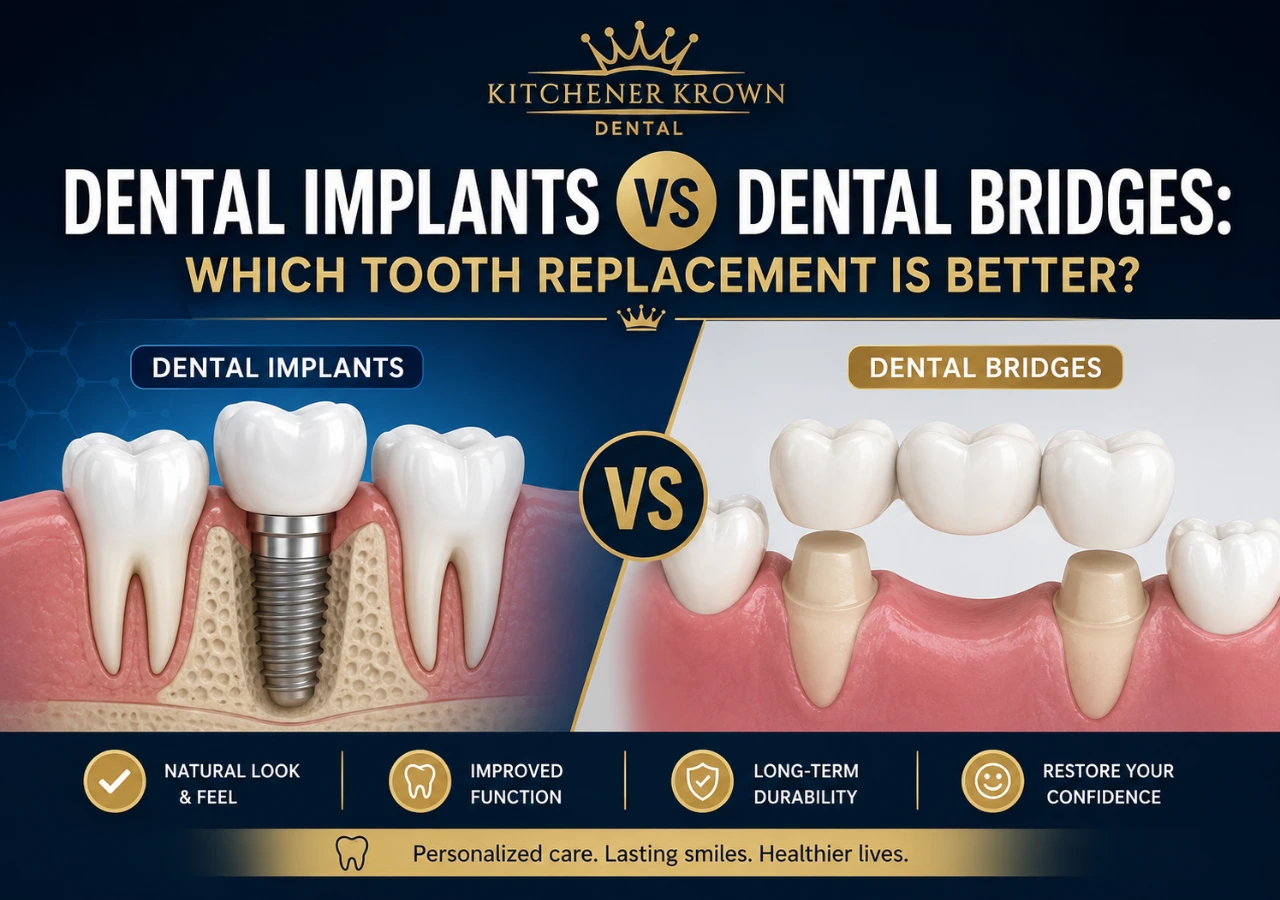
Choosing between dental implants vs dental bridges depends on your oral health, bone density, budget, and long-term goals. Dental implants generally last longer and preserve jawbone, while dental bridges provide a quicker, more affordable solution for many patients. A personalized dental assessment ensures the most suitable treatment.
Missing a tooth affects far more than your smile. It changes how you chew, speak, and even how your jawbone supports your facial structure over time.
As a dentist who has treated patients with missing teeth for many years, I’ve seen firsthand that there isn’t one universal solution. Two patients with nearly identical dental problems often require completely different treatment plans because their lifestyles, oral health, and long-term expectations differ.
One patient may prioritize longevity and bone preservation. Another may simply want a fast, affordable restoration before an important family event.
The goal isn’t just replacing a missing tooth—it’s restoring confidence, function, and lifelong oral health.
In this guide, we’ll compare dental implants vs dental bridges, explain when each option works best, and help you make an informed decision with confidence.
Understanding Tooth Replacement Options
A missing tooth is more than a cosmetic concern.
Without replacement, neighboring teeth gradually drift into the empty space. This can change your bite, increase wear on surrounding teeth, and make cleaning more difficult. Even more importantly, the jawbone underneath the missing tooth begins shrinking because it no longer receives stimulation from a natural tooth root.
According to the Canadian Dental Association, replacing missing teeth helps maintain oral function, chewing efficiency, and overall dental health.
Today, the two most common fixed tooth replacement options are:
-
- Dental bridges
-
- Dental implants
Both restore appearance and chewing ability, but they work very differently.
What Is a Dental Bridge?
A dental bridge is a fixed dental restoration that literally “bridges” the gap left by one or more missing teeth.
Instead of replacing the tooth root, the bridge is supported by neighboring natural teeth or, in some cases, dental implants.
Most traditional bridges include:
-
- Two dental crowns placed over adjacent teeth
-
- One or more artificial teeth (pontics)
-
- A single connected restoration permanently cemented into place
Types of Dental Bridges
There are several types of bridges, each designed for different situations.
Traditional Bridge
The most common option.
Healthy teeth on each side of the gap are prepared to support crowns.
Best for:
-
- One missing tooth
-
- Strong surrounding teeth
-
- Back teeth with heavy chewing forces
Cantilever Bridge
Used when only one neighboring tooth is available.
Because chewing forces are uneven, this design is less common today.
Maryland Bridge
Rather than crowns, this bridge uses metal or porcelain “wings” bonded behind neighboring teeth.
Advantages include:
-
- Minimal tooth preparation
-
- Conservative treatment
-
- Often suitable for front teeth
Implant-Supported Bridge
Instead of relying on natural teeth, implants anchor the bridge.
This option is frequently recommended when replacing multiple adjacent missing teeth because it protects remaining healthy teeth.
Benefits of Dental Bridges
Many patients choose bridges because they offer:
-
- Faster treatment
-
- Lower upfront investment
-
- Fixed (non-removable) restoration
-
- Natural-looking appearance
-
- Restored chewing ability
Treatment usually requires only two to three appointments.
Potential Limitations
Although bridges are an excellent solution for many patients, they have some disadvantages.
Traditional bridges require reshaping healthy neighboring teeth.
Additionally, because no artificial root replaces the missing tooth, jawbone loss continues beneath the bridge over time.
Plaque accumulation beneath the pontic also requires careful daily cleaning using floss threaders or specialized brushes.
What Is a Dental Implant?
A dental implant replaces the entire missing tooth—including its root.
Instead of resting on neighboring teeth, a titanium implant is surgically placed into the jawbone, where it integrates naturally through a process called osseointegration.
Once healing is complete, an abutment and custom porcelain crown are attached.
The result closely resembles a natural tooth in appearance, strength, and function.
Benefits of Dental Implants
Dental implants provide several advantages beyond simply replacing a missing tooth.
Preserve Jawbone
Unlike bridges, implants stimulate the jawbone during chewing, helping prevent bone deterioration.
This preservation supports facial structure and reduces the sunken appearance often associated with long-term tooth loss.
Protect Healthy Teeth
Because implants are self-supporting, neighboring teeth remain untouched.
No grinding or crowning of healthy teeth is required.
Natural Appearance
Well-designed implant crowns closely match surrounding teeth in:
-
- Shape
-
- Color
-
- Size
-
- Bite
-
- Function
Most people cannot distinguish an implant from a natural tooth.
Long-Term Durability
One of the biggest reasons patients choose implants is longevity.
Clinical studies consistently report survival rates exceeding 95% after ten years when properly maintained, based on research from the International Team for Implantology (ITI Consensus Reports).
Dental Bridge vs Implant: The Biggest Differences
While both treatments restore missing teeth, their approach is fundamentally different.
| Feature | Dental Bridge | Dental Implant |
|---|---|---|
| Replaces tooth root | No | Yes |
| Requires surgery | No | Yes |
| Preserves jawbone | Limited | Yes |
| Treatment time | Shorter | Longer |
| Alters neighboring teeth | Usually | No |
| Long-term durability | Good | Excellent |
| Cleaning | Special floss required | Similar to natural tooth |
Is a Dental Implant Better Than a Bridge?
The answer depends on your oral health, lifestyle, and treatment goals—not simply which option is newer or more expensive.
In general, dental implants are considered the gold standard for replacing a single missing tooth because they restore both the crown and root, helping preserve jawbone and avoiding changes to adjacent teeth. However, dental bridges remain an excellent solution for many patients, especially when treatment time, budget, or medical factors make implants less suitable.
A Dental Implant May Be Better If You:
-
- Have healthy gums and adequate jawbone
-
- Want the longest-lasting solution
-
- Wish to preserve surrounding healthy teeth
-
- Prefer a restoration that functions like a natural tooth
-
- Are committed to excellent oral hygiene and routine dental visits
A Dental Bridge May Be Better If You:
-
- Need a faster tooth replacement
-
- Have neighboring teeth that already require crowns
-
- Prefer to avoid oral surgery
-
- Have medical conditions that may delay implant healing
-
- Are looking for a lower upfront investment
How Long Does a Dental Bridge Last?
A common question patients ask is, “How long does a dental bridge last?”
With proper care, most dental bridges last 10–15 years, although many remain functional for longer.
The lifespan depends on several factors:
-
- Daily oral hygiene
-
- Gum health
-
- Bite forces
-
- Teeth grinding (bruxism)
-
- Quality of the supporting teeth
-
- Regular professional dental examinations
Poor oral hygiene can lead to decay or gum disease around the supporting teeth, which is one of the most common reasons bridges require replacement.
Tips to Extend the Life of a Dental Bridge
-
- Brush twice daily with fluoride toothpaste
-
- Floss underneath the bridge using floss threaders or interdental brushes
-
- Attend regular professional cleanings
-
- Wear a nightguard if you grind your teeth
-
- Avoid chewing ice or very hard foods
How Long Do Dental Implants Last?
Another frequently asked question is, “How long do dental implants last?”
Dental implants are designed to be a long-term solution. The implant post itself can often last 25 years or longer, and in many cases, for life with proper care.
The implant crown may eventually require replacement due to normal wear, but the titanium implant typically remains stable if healthy bone and gum tissue are maintained.
Research published by the International Team for Implantology (ITI) reports high long-term success rates, with many implants remaining functional well beyond 20 years in healthy patients.
Factors That Influence Implant Longevity
-
- Consistent oral hygiene
-
- Smoking status
-
- Bone quality
-
- Gum health
-
- Diabetes control
-
- Routine dental maintenance
-
- Bite alignment
Patients who follow preventive care recommendations generally experience excellent long-term outcomes.
All-on-4 Dental Implants: A Solution for Multiple Missing Teeth
For patients missing most or all of their teeth, All-on-4 dental implants provide an innovative alternative to traditional removable dentures.
This treatment uses four strategically positioned implants to support a full arch of replacement teeth.
Benefits of All-on-4 Dental Implants
-
- Fixed, non-removable teeth
-
- Improved chewing efficiency
-
- Better speech stability
-
- Reduced bone loss compared with conventional dentures
-
- Greater confidence and comfort
-
- Fewer implants required than traditional full-mouth reconstruction
All-on-4 treatment may also reduce the need for bone grafting in selected patients because the implants are placed at specific angles to maximize available bone.
Not every patient is a candidate, making a comprehensive examination essential.
Best Treatment for Missing Teeth: It Depends on Your Situation
There is no one-size-fits-all answer when choosing the best treatment for missing teeth.
Below are common clinical scenarios:
| Situation | Recommended Option |
|---|---|
| One missing tooth | Dental implant (preferred) or bridge |
| Two or three adjacent missing teeth | Implant-supported bridge or traditional bridge |
| Multiple missing teeth | Implant-supported restoration |
| Complete tooth loss | All-on-4 dental implants or implant-supported dentures |
| Limited bone availability | Bridge or implant after bone grafting |
| Existing crowned neighboring teeth | Bridge may be appropriate |
A complete oral examination, digital imaging, and discussion of your health history help determine the most appropriate treatment.
Cost Considerations in Canada
Treatment cost is an important factor for many families.
While fees vary depending on the complexity of treatment, geographic location, materials used, and insurance coverage, dental bridges generally have a lower upfront cost, whereas dental implants often provide greater long-term value because they may require fewer replacements over time.
When evaluating treatment, consider:
-
- Expected lifespan
-
- Maintenance requirements
-
- Future replacement costs
-
- Oral health benefits
-
- Insurance coverage
-
- Overall quality of life
Your dental team can provide a personalized treatment estimate and discuss financing options where available.
Preventive Care After Tooth Replacement
Whether you choose a bridge or an implant, long-term success depends on preventive care.
We recommend patients:
-
- Brush twice daily using a soft-bristled toothbrush, a routine recommended by the American Dental Association (ADA)
-
- Clean between teeth every day
-
- Use fluoride toothpaste
-
- Maintain a balanced, low-sugar diet
-
- Attend routine dental examinations and professional cleanings
-
- Address signs of gum disease early
-
- Wear protective appliances if recommended
Preventive care protects not only your restoration but also the surrounding teeth and gums, and good general oral health habits, as highlighted by Health Canada, support lasting treatment success.
Frequently Asked Questions
Is a dental implant better than a bridge?
Dental implants are often the preferred long-term option because they replace the tooth root, preserve jawbone, and do not require altering neighboring teeth. However, a bridge may be more appropriate depending on your oral health, budget, or treatment timeline.How long does a dental bridge last?
Most dental bridges last 10–15 years, and some last longer with excellent oral hygiene, regular dental visits, and proper maintenance.How long do dental implants last?
The implant itself can last 25 years or more, while the crown may eventually require replacement due to normal wear.Are dental implants painful?
Most patients report only mild discomfort after implant placement. Local anesthesia and modern surgical techniques make the procedure more comfortable than many people expect.Are dental bridges removable?
No. Traditional dental bridges are fixed restorations that remain securely attached and are removed only by a dental professional.What is the recovery time for dental implants?
Initial healing usually occurs within a few days, while complete integration with the jawbone generally takes several months before the final crown is placed.What are All-on-4 dental implants?
All-on-4 is a treatment that supports a full arch of replacement teeth using four strategically placed dental implants, offering a stable alternative to removable dentures.Final Thoughts
Choosing between dental implants vs dental bridges is an important decision that affects your oral health for years to come.
Dental implants provide exceptional longevity, preserve jawbone, and protect neighboring teeth, making them an outstanding long-term solution for many patients.
Dental bridges, however, continue to be a reliable, effective option for patients seeking a faster treatment or those who may not be ideal candidates for implant surgery.
At Kitchener Krown Dental, we believe every smile deserves an individualized approach. By combining advanced diagnostic technology, evidence-based dentistry, and personalized treatment planning, we help patients make confident decisions that support lasting oral health.
If you’re considering tooth replacement, schedule a comprehensive consultation. Together, we’ll evaluate your oral health, discuss your goals, and recommend the treatment that best fits your needs.