
Kitchener Krown Dental

emergency dental treatment

Teeth Cleaning
dental, Dental Tips & Care

Why Regular Teeth Cleaning Matters for Healthy Gums

Regular teeth cleaning does more than keep your smile looking fresh — it helps protect the gum tissues surrounding your teeth and plays an important role in maintaining good oral health. While brushing and flossing every day are essential, they may not remove all the plaque and hardened tartar that can accumulate over time. That is where professional teeth cleaning can play an important preventive role. A dental professional can remove buildup from areas that are difficult to clean at home while also checking for signs of gum inflammation, decay, or other oral health concerns. For patients looking for professional teeth cleaning in Kitchener, understanding why regular cleanings matter can make it easier to stay proactive about gum and dental health. Why Is Regular Teeth Cleaning Important? Regular teeth cleaning helps remove plaque, tartar, and surface buildup that brushing and flossing may not completely eliminate. Plaque that remains on teeth can harden into tartar, which cannot be removed with ordinary brushing or flossing. Tartar buildup can contribute to gum inflammation and increase the risk of gum disease. Professional cleaning works alongside daily home care. It is not a replacement for brushing or flossing, but an important part of a preventive oral-health routine. What Happens When Plaque Is Not Removed? Plaque is a sticky film containing bacteria that forms continuously on teeth and along the gumline. Daily brushing and cleaning between your teeth help remove plaque before it becomes harder to manage. When plaque remains on the teeth, it can harden into tartar, also called calculus. Unlike soft plaque, tartar cannot simply be brushed away at home. It requires professional removal. This matters because tartar can accumulate close to the gums and make effective home cleaning more difficult. Over time, this may contribute to gum inflammation. Early gum inflammation is commonly associated with gingivitis. Possible signs include: Gum disease can develop gradually and may not always cause noticeable pain in its early stages. That is one reason regular dental examinations and professional cleanings are valuable. How Teeth Cleaning Supports Healthy Gums Professional cleaning is primarily a preventive service. Its purpose is to remove deposits that cannot be adequately removed through ordinary home care. During a cleaning appointment, a dental professional may remove: Removing this buildup makes it easier to maintain cleaner teeth and healthier gums between appointments. The Canadian Dental Association recommends regular dental examinations and professional cleaning as part of preventive oral care. Cleaning Does More Than Make Teeth Look Cleaner Many people associate a dental cleaning primarily with a fresher smile. While removing surface stains can improve the appearance of teeth, the bigger benefit is maintaining a healthy oral environment. Regular cleaning can help: It is important to remember that a cleaning does not guarantee that cavities or gum disease will never develop. Oral health depends on multiple factors, including daily hygiene, diet, lifestyle, medical conditions, and individual risk. Why Brushing and Flossing Are Still Essential Professional teeth cleaning should complement—not replace—your daily oral hygiene routine. Health Canada recommends brushing for about two minutes at least twice a day and cleaning between the teeth daily. A simple daily routine can include: Brush Twice a Day Use a soft-bristled toothbrush and fluoride toothpaste. Brush all surfaces of the teeth, including the areas near the gumline. Clean Between Your Teeth Daily Floss or use another appropriate interdental cleaner to remove plaque and food particles between teeth. The Canadian Dental Association and American Dental Association both emphasize interdental cleaning because toothbrush bristles cannot effectively reach every area between teeth. Pay Attention to Your Gums Look for changes such as redness, swelling, bleeding, or persistent bad breath. If these symptoms continue, a dental professional can assess the underlying cause. Who May Benefit From More Frequent Teeth Cleaning? There is no single cleaning schedule that works equally well for every patient. Some people may need more frequent professional care depending on their oral-health needs and risk factors. A dental professional may recommend closer monitoring if you have: The appropriate interval should be based on your dental examination and individual needs rather than simply following a fixed schedule. For example, someone with minimal tartar and healthy gums may have different preventive needs from someone who regularly develops significant buildup. Signs You May Need a Professional Dental Cleaning You do not always need to wait until your teeth feel uncomfortable before scheduling an appointment. Consider speaking with a dental professional if you notice: Bleeding Gums Occasional bleeding should not automatically be ignored. Persistent bleeding during brushing or flossing can be a sign of gum inflammation. Visible Tartar Yellow, brown, or hardened deposits around the gumline may indicate tartar buildup. Because tartar cannot be removed effectively with ordinary brushing, professional cleaning may be needed. Persistent Bad Breath Bad breath that does not improve with regular brushing and cleaning between the teeth can sometimes be associated with plaque, gum problems, or other oral-health concerns. Swollen or Red Gums Healthy gums are generally firm and resistant to bleeding. Persistent swelling or redness deserves professional attention. It Has Been a Long Time Since Your Last Visit If you have not had a dental examination or cleaning for a long period, a professional assessment can help determine what your teeth and gums currently need. What Is the Difference Between Plaque and Tartar? The terms are sometimes used interchangeably, but plaque and tartar are not the same. Plaque Tartar Soft, sticky bacterial film Hardened mineral deposit Forms continuously Develops when plaque remains on teeth Can be removed with effective daily cleaning Requires professional removal Builds up around teeth and gums Can accumulate along and below the gumline The distinction is important because daily brushing and interdental cleaning are designed to control plaque, while professional cleaning is needed to remove hardened tartar. Can Teeth Cleaning Prevent Gum Disease? Professional cleaning is one component of gum-disease prevention, but it cannot work by itself. Gum health depends on consistent home care, professional examinations, lifestyle factors, and treatment when problems are identified. The Canadian Dental
overbite vs underbite
dental, Dental Tips & Care

Can Invisalign Fix Overbite, Underbite and Crowded Teeth?

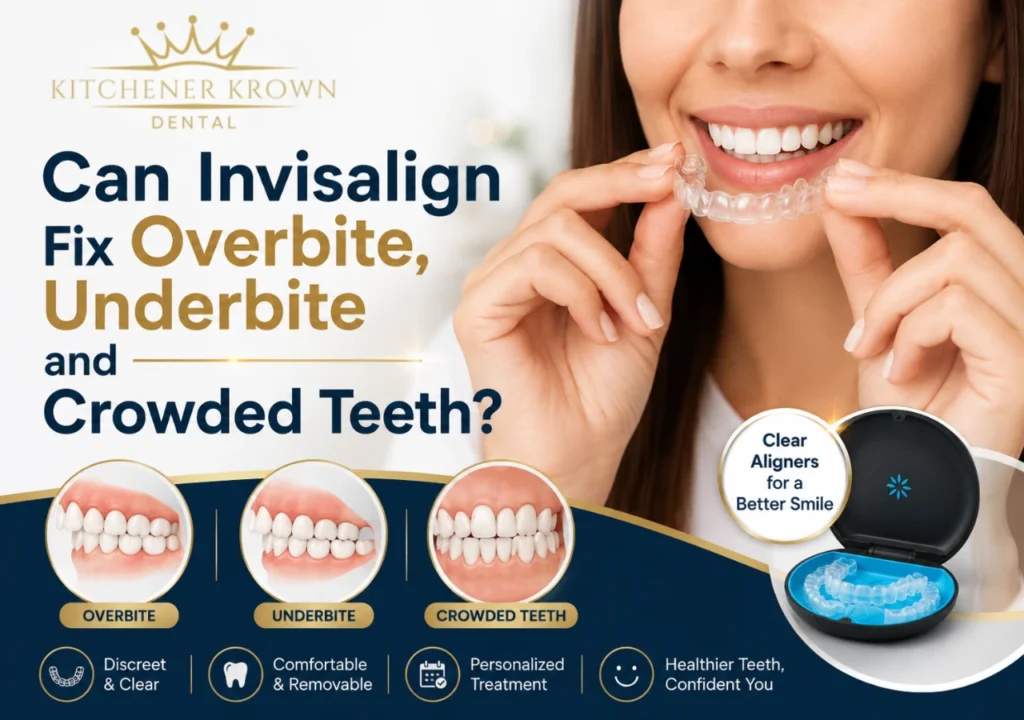
Overbite vs underbite is one of the first questions many patients ask before starting orthodontic treatment. Yes, Invisalign can correct many cases of overbite, underbite and crowded teeth when the required changes can be achieved through controlled tooth movement. However, clear aligners are not suitable for every bite problem. The severity, cause, tooth position, jaw relationship, gum health and treatment goals all influence which orthodontic approach is appropriate. If you are considering Invisalign in Kitchener, it is important to understand that orthodontic treatment involves more than making teeth look straighter. A patient may have crowded teeth but a relatively healthy bite. Another patient may have an overbite or underbite that affects how the upper and lower teeth meet. In some cases, the problem is primarily related to tooth position. In others, the relationship between the jaws plays a major role. That difference can determine whether Invisalign alone is appropriate. At Kitchener Krown Dental, Invisalign is offered as part of the clinic’s dental services for suitable patients. The practice provides dental care for children, adults and families in Kitchener, Ontario. What Is the Difference Between an Overbite and an Underbite? An overbite occurs when the upper front teeth overlap the lower teeth vertically, while an underbite occurs when the lower front teeth sit in front of the upper front teeth. Both are types of malocclusion, a term used to describe an abnormal relationship between teeth or jaws. When comparing overbite vs underbite, the direction of the misalignment is the main distinguishing factor. Understanding overbite vs underbite is useful because the two conditions can have different causes and treatment requirements. What is an overbite? A small amount of vertical overlap between the upper and lower front teeth is normal. An excessive overlap is generally described as an increased overbite or deep bite. Depending on its severity, an excessive overbite may be associated with: Not every overbite needs orthodontic correction. A dental professional evaluates the bite to determine whether it is affecting oral health, function, comfort or tooth stability. What is an underbite? An underbite occurs when the lower front teeth extend ahead of the upper front teeth when the mouth is closed. An underbite may be related to: This distinction is important because Invisalign primarily moves teeth. If the problem is mainly dental, controlled tooth movement may improve the bite. If there is a significant skeletal discrepancy involving the jaws, clear aligners alone may not provide complete correction. The American Association of Orthodontists identifies underbite as one condition that may be treated with clear aligners, while emphasizing that treatment depends on the individual case. Can Invisalign Correct an Overbite? Yes, Invisalign can correct many overbites by gradually repositioning teeth and improving the relationship between the upper and lower dental arches. The amount of correction possible depends on the severity and cause of the overbite. Regardless of which side of the overbite vs underbite comparison applies to you, the treatment approach starts with the same careful evaluation. Invisalign uses a series of custom-made clear aligners designed to apply controlled forces to specific teeth. Depending on the treatment plan, aligners may be used to address: However, correcting an overbite is not necessarily as simple as moving the upper front teeth backward. The entire bite needs to be considered. How do you fix an overbite? The appropriate treatment depends on what is causing the overbite and how severe it is. Possible treatment approaches include: The American Association of Orthodontists recognizes clear aligners as a treatment option for some orthodontic conditions while noting that they are not appropriate for every patient. When may Invisalign be appropriate for an overbite? Invisalign may be considered when: The important factor is clinical suitability, not simply the desire to use clear aligners. Can Invisalign Fix an Underbite? Invisalign can fix some underbites, particularly when the problem is primarily related to tooth position. More significant skeletal underbites may require braces, additional orthodontic treatment or specialist care. In the overbite vs underbite comparison, underbites are generally more likely to involve a skeletal component. This is why the answer to “Can Invisalign fix underbite?” is not the same for every patient. Consider two people with an underbite. One may have lower front teeth positioned slightly too far forward while the underlying jaw relationship is suitable for orthodontic tooth movement. Another person may have a significant difference in the position or development of the upper and lower jaws. Although both patients may appear to have an underbite, their treatment needs can be very different. How do you fix an underbite? Depending on the cause, treatment may involve: A dental assessment helps determine whether the underbite is primarily dental, skeletal or a combination of both. This distinction is especially important for adults because the position of the jaw itself cannot simply be changed by moving teeth with clear aligners. Can Invisalign Straighten Crowded Teeth? Yes, Invisalign can straighten many cases of crowded teeth by gradually moving teeth into better positions. The severity of crowding, available space, tooth position and overall bite determine whether clear aligners are appropriate. Crowding occurs when there is not enough space for teeth to align normally within the dental arch. Crowded teeth may: Crowding is one of the common orthodontic concerns that may be treated with clear aligners. Why do crowded teeth matter? Crowded teeth are not necessarily only a cosmetic concern. When teeth overlap, certain areas may be harder to reach with a toothbrush or floss. That can make plaque control more challenging. The American Dental Association notes that orthodontic treatment can address crowded or crooked teeth and abnormal bites, while the American Association of Orthodontists also recognizes oral-hygiene challenges associated with crooked or crowded teeth. Improving alignment may make some areas easier to clean, but orthodontic treatment does not replace daily brushing, flossing or routine dental care. Overbite vs Underbite: Which Is More Difficult to Correct? Neither an overbite nor an underbite is automatically more difficult to treat. The complexity depends on the cause, severity and amount of

emergency dental treatment
dental, Dental Tips & Care

Emergency Dental Treatment: 10 Early Signs You Need a Dentist Immediately

Emergency dental treatment is appropriate when pain, swelling, bleeding, infection, or tooth damage could worsen without prompt care. Severe toothache, facial swelling, a knocked-out permanent tooth, significant cracks or breaks, and uncontrolled bleeding deserve urgent assessment. Knowing the warning signs helps you act quickly, protect your natural teeth, and avoid preventable complications. What Is Emergency Dental Treatment? Emergency dental treatment is care for a dental problem that requires prompt assessment because delaying it could increase pain, infection, tissue damage, or the risk of losing a tooth. Common examples include severe toothache, dental abscesses, significant tooth fractures, dental trauma, uncontrolled oral bleeding, and knocked-out permanent teeth. The important distinction is that not every uncomfortable dental problem is an emergency. A small cosmetic chip without pain may be suitable for a regular appointment, while a knocked-out adult tooth needs immediate attention. At Kitchener Krown Dental, the dental team provides family and restorative care alongside emergency appointments. The safest approach is to judge a dental problem by its symptoms, severity, speed of progression, and potential to damage the tooth or surrounding tissues. 1. Severe Toothache: A Common Dental Emergency Sign A severe toothache is one of the most common reasons people seek emergency dental treatment. Pain may come from advanced tooth decay, inflammation of the dental pulp, infection, trauma, a cracked tooth, or a problem beneath an existing filling or crown. Pay particular attention when tooth pain: The Canadian Dental Association recommends contacting your dentist for toothache and specifically advises against placing pain medication directly on the sore tooth. A Useful Rule Pain that repeatedly returns is information. Pain that is becoming stronger is a reason to act. Do not assume that pain disappearing means the tooth has healed. In some situations, a change in pain can occur as the tissue inside a severely damaged tooth deteriorates. 2. Facial, Jaw, or Gum Swelling: When You Need Emergency Dental Care Swelling around a tooth, gum, cheek, or jaw can be a sign of infection. A dental infection may develop when bacteria enter the pulp of a tooth or the surrounding tissues. Signs can include: Kitchener Krown Dental identifies swelling and persistent tooth symptoms among reasons patients should seek dental assessment. Its root canal service also lists swelling, abscesses, severe pain, and lingering sensitivity as symptoms that may require treatment. If swelling is rapidly increasing or you have difficulty breathing or swallowing, seek emergency medical care rather than waiting for a routine dental appointment. Those symptoms can indicate that an infection is extending beyond the immediate tooth area. 3. A Cracked Tooth Causes Sharp Pain When You Bite A cracked tooth can be surprisingly difficult to diagnose at home. You may experience a sharp sensation when biting down, pain when releasing your bite, sensitivity to temperature, or intermittent discomfort that seems to disappear between episodes. The problem is that chewing places repeated forces on the tooth. A crack that begins relatively small can progress and involve deeper tooth structures. Treatment depends on factors such as: Potential treatment can include bonding or another restoration, a crown, emergency root canal treatment when the pulp is affected, or extraction when the tooth cannot be saved. Until you are assessed, avoid chewing hard foods on the affected side. 4. A Broken or Chipped Tooth: A Dental Emergency, Not Just a Cosmetic Problem A small chip without pain may not require emergency care. A significant broken tooth, however, deserves prompt assessment—particularly when there is bleeding, severe sensitivity, or pain. A fracture can expose the inner portion of the tooth and make it more vulnerable to bacterial contamination and further structural damage. The Ontario Dental Association recommends contacting a dentist promptly after a significant broken or chipped tooth and advises patients to bring any recovered tooth fragment to the appointment. Depending on the injury, a dentist may recommend: Kitchener Krown Dental provides restorative services including fillings, crowns, bridges, and other treatments for damaged teeth. 5. A Knocked-Out Permanent Tooth: A Time-Sensitive Dental Emergency A knocked-out permanent tooth is one of the clearest dental emergencies. The goal is to get professional care as quickly as possible because the time outside the mouth can affect the possibility of successfully repositioning the tooth. If an adult tooth is knocked out: The Ontario Dental Association notes that a permanent tooth may be replanted and that acting quickly is important. It also advises never attempting to reinsert a knocked-out baby tooth, because doing so can damage the developing permanent tooth. Adult Tooth vs. Baby Tooth This is an important distinction for parents. 6. Uncontrolled Oral Bleeding: A Dental Emergency That Needs Urgent Care Bleeding can occur after an injury, tooth extraction, or other dental problem. A small amount of bleeding may be expected in some circumstances. Persistent or heavy bleeding is different. Until you receive professional advice, apply firm, gentle pressure with clean gauze or cloth. Avoid repeatedly removing the material to check whether the bleeding has stopped. Seek urgent professional assistance if bleeding remains uncontrolled. If the bleeding follows major facial trauma, a significant head injury, fainting, or another serious injury, medical emergency care may be more appropriate. 7. A Dental Abscess: A Serious Dental Emergency With Pus or a Bad Taste A dental abscess is a localized collection of infection associated with a tooth or surrounding tissues. Possible warning signs include: One of the most important misconceptions about an abscess is that less pain does not necessarily mean the infection is gone. If pressure is released and drainage occurs, pain may temporarily decrease while the underlying source remains. Treatment depends on the diagnosis. Depending on the tooth and extent of infection, a dentist may recommend drainage, root canal treatment, restoration, or extraction. Antibiotics may be appropriate in certain situations, but they do not automatically eliminate the dental source of an infection. The underlying tooth or tissue still needs appropriate dental assessment. 8. Severe Sensitivity to Hot or Cold Lingers Not all sensitivity means you need emergency dental treatment. Brief sensitivity that disappears immediately

Scroll to Top